
A Sucker for evidence
Forensic expertise area: Crime scene investigations/ engineering
Short description
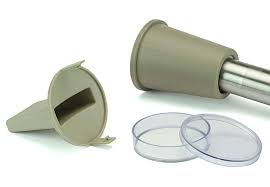
In crime scene investigations the collection of trace evidence is of great importance. One of the methods for securing several traces is the vacuum method. This method consists of a vacuum combined with a special filter system (VacuuMark). This method seems to be effective for securing several types of traces, including glass particles, explosive residue and narcotics. Several countries in Europe also use this method for securing DNA-evidence (source: ENFSI SOC working group).
However, the method has some downsides as well. Studies have shown that particles are being collected on the outside of the filter holder, increasing the risk of contamination and the loss of evidence. It’s unclear what types of traces can be collected, and what the collection efficiency is. It might well be possible that optimisation of the filter design could lead to higher yields and lower contamination rates.
In the beginning of 2025 the Sucker for evidence project started at the Dutch police, in collaboration with the Amsterdam University of Applied sciences. A literature review of the method, looking for example at the types of traces, the design of the method and filters, and the method of appliance in general, could be very beneficial for the project.
References
- Trace evidence
- Crime scene investigations
- Vacuum method
Required/Recommended skills and expertise
- Forensic sciences
- Engineering/product development
Information
Institute/ Company: Politie Noord-Holland (Dutch Polce)
Department: Forensische Opsporing
Country: The Netherlands
Supervisor: Raoul de Graaff
Uva Examiner: tbd
Uva Coordinator: Arian van Asten/ Yorike Hartman
Date of publication: September 19, 2025