
Estimating the time since deposition (TSD) of blood
Forensic expertise area : Biochemistry, Biophysics
Short description
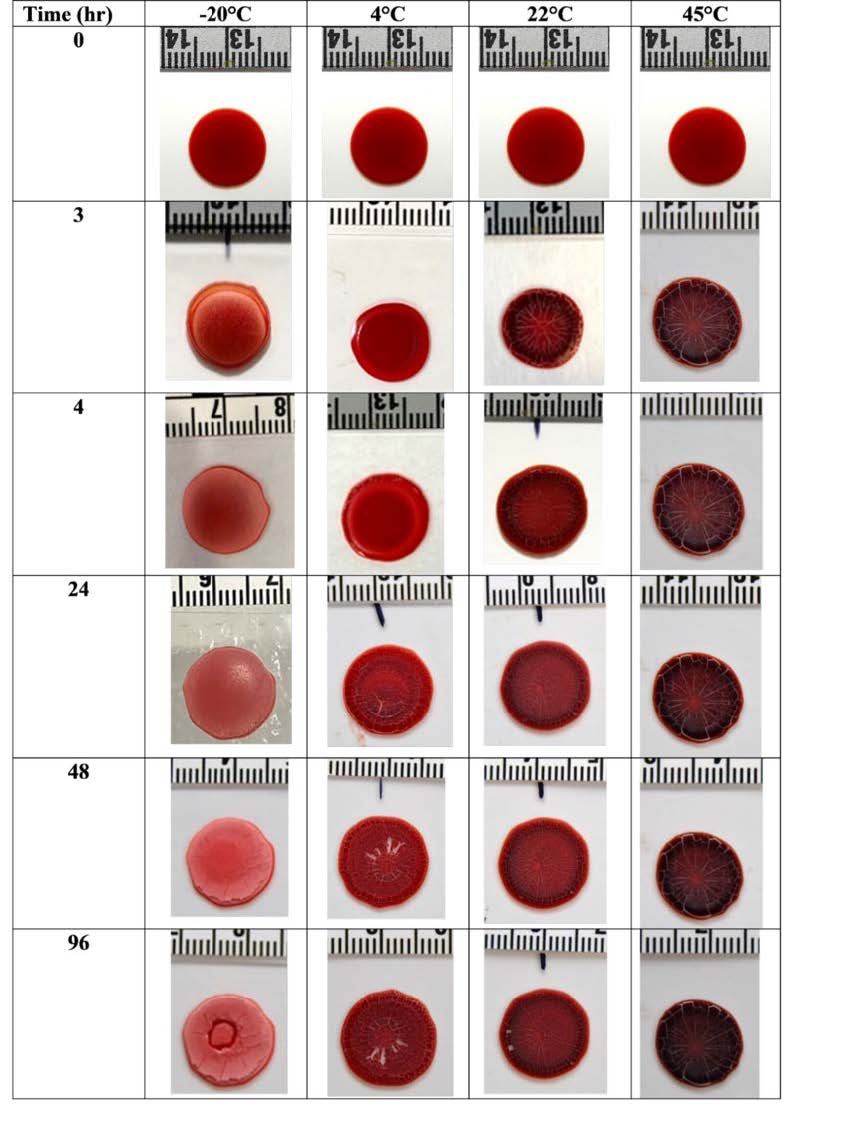
Estimating the time since a biological trace was deposited at a crime scene is a significant challenge in forensic science. Currently, there is no standardised or widely accepted method for estimating the time since deposition (TSD) of biological evidence. This is particularly challenging and critical in cases where a defendant acknowledges that they are the source of a trace but assert that the trace was deposited prior to the crime occurring. Reliable ageing techniques would provide invaluable support to law enforcement by enabling the reconstruction of event timelines, enhancing the evaluation of trace relevance, and corroborating or challenging witness statements.
The development of reliable TSD methodologies is particularly challenging due to the multifaceted influence of donor characteristics, deposition conditions, and environmental factors on the degradation processes of biological traces. Numerous analytical approaches have been applied to identify potential ageing markers in blood, tested under diverse conditions and over varying temporal scales [1-3]. However, these efforts have yet to yield universally reliable or practical solutions.
We invite applications from highly motivated students interested in undertaking a comprehensive review and critical analysis of current methodologies in this fascinating domain. The project will involve the:
• Systematic compilation of methods estimating the TSD of blood and ageing markers identified from scientific literature.
• Critical evaluation of the strengths and limitations of these approaches for the forensic field.
• Examination of how intrinsic and extrinsic factors affect the accuracy and reliability of blood TSD estimations.
• Identification of existing knowledge gaps and future research perspectives within this domain.
References
1) Schneider, T. D., et al. (2022). Determination of the time since deposition of blood traces utilizing a liquid chromatography–mass spectrometry-based proteomics approach. Analytical Chemistry, 94(30), 10695–10704. https://doi.org/10.1021/acs.analchem.2c01009
2) Schneider, T. D., Kraemer, T., & Steuer, A. E. (2023). Determination of the time since deposition of blood‐traces in a forensic context: Application of untargeted LC‐HR‐MS/MS metabolomics profiling. Drug Testing and Analysis, 15(8), 840–852. https://doi.org/10.1002/dta.3480
3) Weber, A., Wójtowicz, A., & Lednev, I. K. (2021). Post deposition aging of bloodstains probed by steady-state fluorescence spectroscopy. Journal of Photochemistry and Photobiology B: Biology, 221, 112251. https://doi.org/10.1016/j.jphotobiol.2021.112251
4) Bremmer, R. H., Nadort, A., van Leeuwen, T. G., van Gemert, M. J. C., & Aalders, M. C. G. (2011). Age estimation of blood stains by hemoglobin derivative determination using reflectance spectroscopy. Forensic Science International, 206(1–3), 166–171. https://doi.org/10.1016/J.FORSCIINT.2010.07.034
Required/recommended skills and expertise
Background in analytical chemistry, biology, biochemistry, or biophysics
Information
Institute/ Company: Netherlands Forensic Institute (NFI) and Saxion Hogeschool
Department: Chemical and Physical Traces/Research and Development
Country: The Netherlands
Supervisor: Andreea Iris Gergely
Uva Examiner: Maurice Aalders
Uva Coordinator: Arian van Asten/ Yorike Hartman
Date of publication: September 9, 2025