Virtualization of stabbing marks from knives
SHORT DESCRIPTION
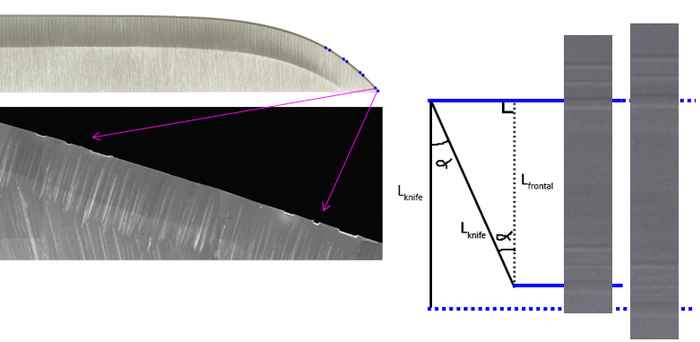
Stabbing with a knife is frequently seen in homicide cases and is therefore frequently part of the forensic investigation process. The forensic comparison between a knife and marks left in the human (coastal) cartilage is part of the expertise of the toolmark examiner at the NFI. The examiner creates testmarks with the suspected knife in cartilage simulation material. The testmarks (and the marks left in the human cartilage) consist of a striation pattern, like a barcode. Various parameters influences the exact barcode pattern like angle of attack, shape of the knife and irregularities on the knife cutting edge. By evaluating the similarities and differences between the test-barcodes and victim-barcode, the examiner draws a conclusion on the likelihood ratio of the findings given the prosecutor and defence hypothesis. Currently this comparison and evaluation process is an observer-based technique based on examiner experience and previous case knowledge. To increase the time-efficiency, objectivity and robustness of this entire process, we would like to use computer assisted comparison and evaluation. Software for comparing the striation patterns (barcodes) is already available. However, we also want to virtualise the process of creating testmarks by developing prediction software that predicts the striation patterns (barcodes) of a knife as a function of the angle of attack, shape of the knife and irregularities of the knife cutting edge. Furthermore, this prediction software can help in simulating lots of different knife configurations, creating a virtual database with striation patterns (barcodes). Subsequently, this virtual database can assist in assessing the occurrence of certain striation patterns which will help in determining the likelihood ratio in an actual case.
REQUIRED/RECOMMENDED EXPERTISE
- Experience in programming (preferably in Matlab)
- Mathematics / Statistics
- Computational Analysis / Scientific Computing
REFERENCES
| Institute/Company: | Netherlands Forensic Institute | |
| Department: | Weapons & Toolmarks | |
| City: | The Hague | |
| Country: | Netherlands | |
| Supervisor: | Koen Herlaar | |
| UVA Examiners : | Erwin Mattijssen | |
| UVA Coordinator : | Arian van Asten |