Isotope ratio analysis approaches relevant to forensic chemistry and chemical weapon attribution (CWA)
Short Description
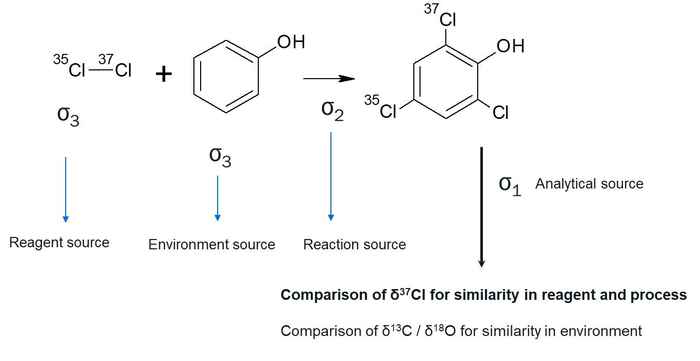
Isotope ratio analysis can be broadly classified into total isotope ratio determination through elemental analysis (e.g. EA-IRMS), compound specific isotope ratio analysis (e.g. GC or LC-IRMS), and position specific isotope ratio analysis (e.g. GC or LC-HRMS or H-NMR). Each approach can have some potential in characterising a compound/matrix/exhibit as it relates to its origin or present the capability for association/linkage with a process. Some of the questions that arise are how established each approach is for forensic analysis and in particular CWA, what are the differences between natural product/origin differentiation that is somewhat established (e.g. food authenticity and sports doping) from repeated synthetic processes that may have greater variability (different source material, different synthesis processes), what are the methods that exist to link elements that are reactive in a process (e.g. chlorine) to ones that may remain inactive in formation/reaction (e.g. sulfur in sulfur mustard to thiodiglycol) through isotope ratio analysis. Further considerations include state of the art regarding the available analytical platforms that seem viable, what are the current limitations, what validation may be needed to establish the science for CWA application in chemical forensics.
References
1) Isotope ratio method: state-of-the-art of forensic applications to CBRNE materials. https://doi.org/10.1080/00085030.2022.2054109
2) A guide to precise measurements of isotope abundance by ESI-Orbitrap MS. https://doi.org/10.1038/s41596-024-00981-5
3) Simultaneous observation of 2H and 13C enrichment of methyl phosphonic acid via Orbitrap-IRMS with applications to nerve agent forensics. https://doi.org/10.1016/j.talanta.2024.126802.
4) Position specific isotope analysis of diethylamine by 2H and 13C NMR – Dual nucleus analysis in forensic investigation of illegal use of chemical weapons. https://doi.org/10.1016/j.talanta.2025.128912
Required/Recommended skills and expertise
- Strong analytical chemistry - instrumental techniques (HRMS, NMR) required
- Knowledge of organic chemistry recommended
Information
Institute/ Company: OPCW
Department: Laboratory
Country: The Netherlands
Supervisor: Adriaan Marais/ Daan Noort
Uva Examiner: Arian van Asten
Uva Coordinator: Arian van Asten/ Yorike Hartman
Date of publication: September 30, 2025